

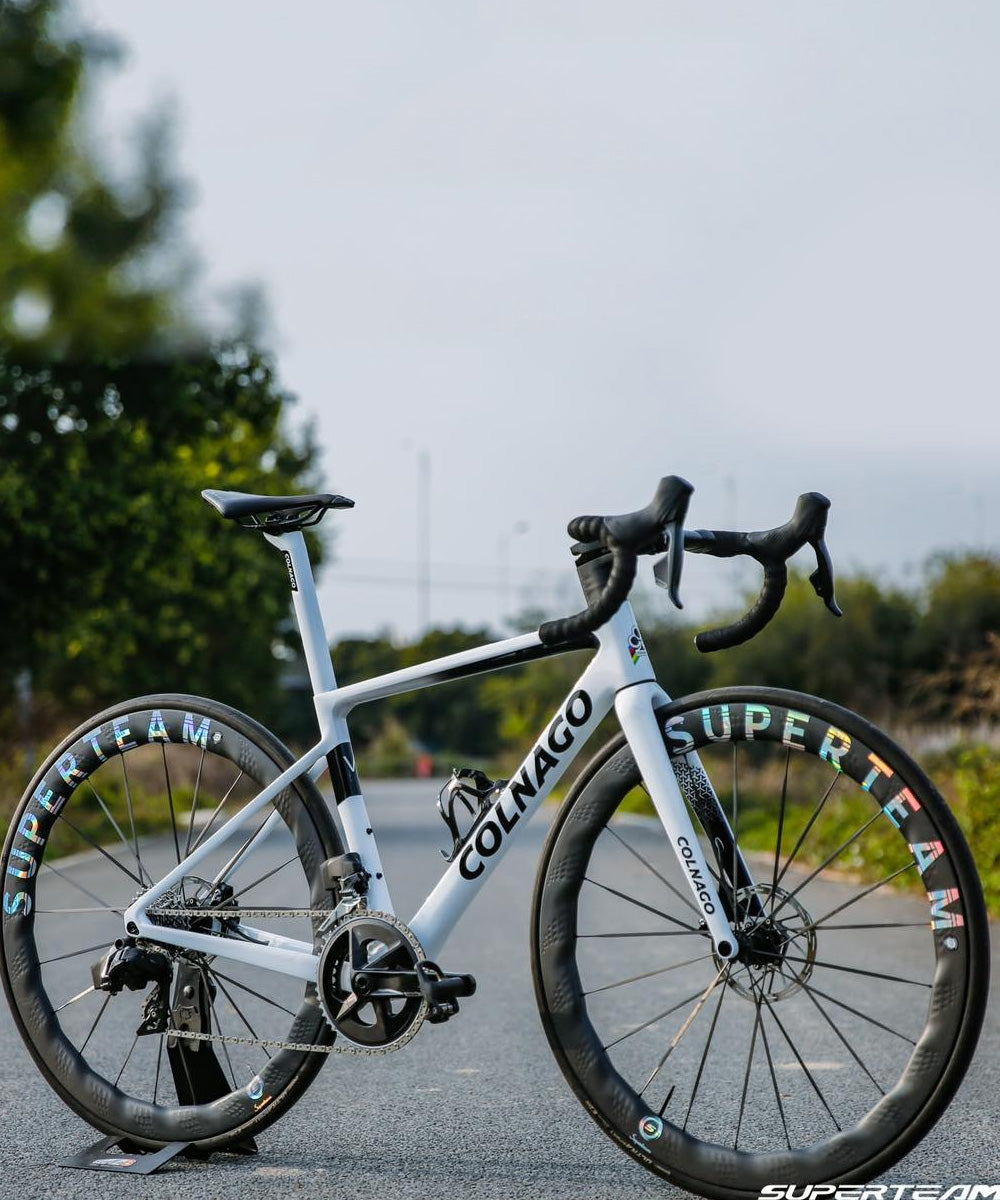


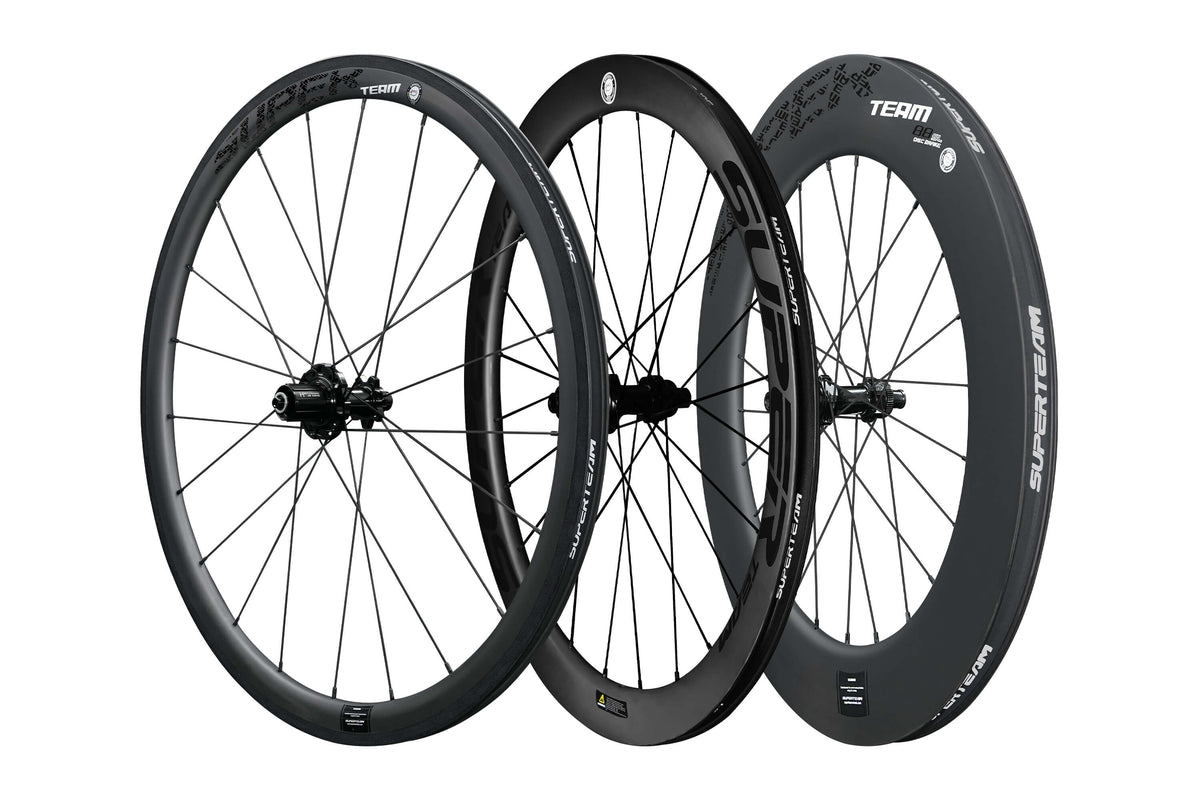
How should you choose your rim depth? Whether it’s 30mm, 50mm, 80mm, or even deeper—or solid disc wheels—these figures determine not just the look of your wheelset, but also profoundly influence your riding experience. Which one suits you best? Today, we’ll use physics and data to break down the numbers for you.
What does rim depth affect?
Regardless of the wheel type, rim depth primarily alters three factors: aerodynamic drag, rotational inertia, and crosswind stability. These factors involve trade-offs; no single rim depth excels in every category.
Let’s look at aerodynamics first. At speeds around 45 km/h (typical for professional racing), switching from a 30mm shallow rim to a 50mm mid-depth rim saves approximately 3 to 5 watts of power; switching to an 80mm deep-section rim saves 8 to 12 watts. This difference is real, but note that the savings increase with higher average speeds; for the average rider, the actual benefit is minimal. Aerodynamic gains are proportional to the cube of the speed; if you typically ride at just over 30 km/h, the benefit of deep-section wheels drops by more than half—sometimes becoming negligible. For instance, while switching from 30mm to 50mm saves 3–5 watts at 45 km/h, that saving drops to only about 1–1.5 watts at 30 km/h. That figure might seem insignificant, but if you maintain an average speed of 30 km/h for an hour, a 1.5-watt advantage could let you cover an extra 80–100 meters or save about 10 seconds. While this gap may seem small in long-distance training or racing, for riders chasing peak performance, every second counts. However, if you are doing a casual ride of ten or twenty kilometers—or a slightly longer ride with breaks and traffic lights—those 10 seconds become trivial, and shallow-rim wheelsets might actually be more practical.

Next, consider rotational inertia. The deeper the rim, the heavier it is, and the more mass is concentrated at the outer edge of the rim—all of which increase rotational inertia. However, it is important to note that there is actually little difference in weight between low-profile and high-profile rims in load-bearing areas like the tire bed and spoke holes; the primary weight increase comes from the sidewalls. Consequently, the actual increase in rotational inertia is not as significant as one might think. Taking 30mm and 50mm rims as examples, the weight difference per wheel is about 50 grams. This mass is concentrated at a radius of approximately 0.28 meters (rather than the outermost edge; the measured rim radius with a 28c tire is about 0.3425 meters). Based on this, with identical tire setups, the rotational inertia of a 50mm rim is roughly 20–30% higher than that of a 30mm rim, while an 80mm rim is 40–60% higher. How does this manifest during a ride? The extra power required for acceleration on flat terrain is merely 0.3–0.5 watts—a negligible amount.

Next, let’s consider climbing—this is where your choice is truly put to the test. Again, using the switch from 30mm to 50mm wheels as an example: on a 10km climb with a 5% gradient, ridden at a steady 10 km/h, the theoretical time difference (assuming no wind, stable road conditions, and no breaks) is about 3 seconds faster for the 50mm wheels, and about 6 seconds faster for the 80mm wheels. Statistically speaking, this difference is virtually imperceptible to amateur riders. So, the question arises: if weight has such a minimal impact, under what circumstances does the aerodynamic advantage begin to dominate on climbs?
Here, we cite a classic study conclusion from Swiss Side: for the average rider, the weight advantage only outweighs the aerodynamic advantage when the average gradient exceeds 4.5%; for professional riders, this critical gradient threshold is around 7.5%. This conclusion effectively illustrates how the balance shifts depending on speed levels.

Finally, there is crosswind stability—the biggest weakness of high-profile rims.

Low-profile 30mm rims are the least affected by crosswinds. In conditions with an average wind force of level 4–5, they remain largely controllable even when facing occasional gusts exceeding level 6. Of course, when average wind speeds exceed Force 6, official safety guidelines already advise against riding or suggest limiting it; even low-profile wheels cannot eliminate the safety risks posed by strong winds.
 [Even professional cyclists will form a single-file line when facing strong crosswinds.]
50mm mid-profile wheels can produce a noticeable tugging sensation in gusty conditions, though most riders can manage them. With 80mm wheels, however, crosswinds act like a sail, pushing against the handlebars; lighter riders might even feel as though the front end is being suddenly jerked or lifted. As a rule of thumb, riders weighing less than 65kg should exercise caution when using rims deeper than 60mm, paying extra attention to bike handling on sections exposed to strong crosswinds.
"Critical Gradient": When do aero wheelsets lose out to lightweight ones?
 [The diagram above illustrates the relationship between gradient percentage and actual slope angle: a 10% gradient means gaining 10 meters in elevation for every 100 meters of horizontal forward movement. A 100% gradient corresponds to a 45-degree slope.]
In the realm of bike frame selection, there is a classic concept known as the "critical gradient": when the slope exceeds a certain value, a lightweight climbing bike outperforms an aero bike; below that value, the aero bike holds the advantage. This same logic applies to the choice of wheelset rim depth.
According to research by Swiss Side, the performance outcome between aero wheelsets and lightweight wheelsets during a climb depends on your power-to-weight ratio (W/kg). Take a rider producing 3 W/kg, for example: aero wheelsets begin to show an advantage when the gradient is below 5%. It is only when the gradient exceeds 6–8% that lightweight wheelsets truly gain the upper hand. Therefore, for most amateur cyclists—unless you start climbing a very steep slope immediately upon setting out (where the average gradient is <4.5%)—aero wheelsets remain the faster overall choice. Even though your speed is lower, the aerodynamic benefits of the wheels persist, whereas the time saved through weight reduction is negligible; a weight difference might only account for 1–2 seconds over a 20-minute climb.

If you are an advanced rider weighing 70 kg and producing 300 W (approximately 4.3 W/kg), the critical gradient is around 6–7%. When the gradient exceeds 7%, switching to a pair of lightweight, low-profile wheels (which are about 200–300 g lighter than high-profile ones) will make you faster; below 7%, high-profile aero wheels hold the advantage.
If you can produce 400 W (approximately 5.7 W/kg, comparable to a professional flat-terrain specialist), the critical gradient rises to 8–9%. This means that, unless you are tackling an extremely steep climb, you will always be faster riding high-profile wheels.

This explains why top climbers in the Tour de France—such as Vingegaard and Pogačar—still opt for aero frames and deep-section wheels on mountainous stages. Their power-to-weight ratio exceeds 6 W/kg, and the "crossover gradient" (the slope at which the benefits of aerodynamics are outweighed by the penalty of extra weight) is over 10%, whereas the average gradient of most Tour de France climbs rarely exceeds 9%. For them, the aerodynamic gains almost always outweigh the weight penalty.
So, what does this crossover gradient mean for the average cyclist? It’s simple: first, estimate your own power-to-weight ratio. If your average speed on flat terrain is under 30 km/h, your power-to-weight ratio is likely below 3 W/kg. In this case, you don't need to agonize over rim depth; instead, focus on comfort and crosswind stability, as the differences in aerodynamics or weight will be barely perceptible to you. If you frequently tackle long climbs exceeding 8% and maintain a power-to-weight ratio above 4 W/kg, then lightweight, shallow-rim wheels can indeed offer a tangible advantage (saving over ten seconds every 10 kilometers). However, if you don't meet those benchmarks—or are simply undecided—a "best-of-both-worlds" approach is ideal: for a mix of flat-road riding and occasional climbing, a 50mm mid-depth rim is almost always the most balanced choice. (For those who *do* perceive a difference, it may be due to sensing the rotational inertia of the wheels during sudden accelerations.)
How to choose based on the scenario?
Combining the physical principles and critical slope gradients mentioned earlier, here are some specific recommendations:

If you primarily ride on flat roads, or participate in triathlons or time trials, an 80mm rim or even a disc wheel is the top choice. You get maximum aerodynamic benefits, and the most comfortable "flywheel effect" (momentum maintenance); plus, race routes usually avoid extreme weather, keeping crosswind risks manageable. Heavier riders have an advantage here—with the same rim depth, you will be much more stable than a lighter rider.

If you face rolling terrain or mixed road conditions, or simply plan to buy one wheelset to handle all your riding, a depth of around 50mm offers the best balance. It addresses aerodynamics, weight, and crosswind stability—making it the most common rim depth range on the market. For most amateur cyclists, choosing this range is a safe bet that rarely goes wrong.
If you are a climbing enthusiast, or ride in areas with many curves and strong winds—and your power-to-weight ratio exceeds 4W/kg—then opt for a low-profile rim of 30 to 40mm. The acceleration response from reduced weight and the lack of crosswind issues are far more tangible benefits than gaining a few watts of aerodynamic efficiency. Climbing wheels are meant for climbing; don't torture yourself by taking deep-section wheels up steep hills.
For urban commuting and daily training, anything from 35mm to 50mm works fine. For these purposes, aesthetics and durability matter far more than minor performance differences; simply choose a wheelset that appeals to your eye.
Don't be fooled by "feel"

Many cyclists feel that riding on the flats becomes much easier and livelier after switching to deep-section wheels. This sensation doesn't actually stem from aerodynamic gains, but rather the "sense of maintained speed" provided by the flywheel effect—you don't have to focus constantly on holding your speed, as the wheels accommodate fluctuations in your power output. A power meter reveals the truth: the power required to maintain a certain speed is indeed lower, but usually only by three to eight watts—far less dramatic than the subjective feeling suggests. So, when choosing a wheelset, use logic to analyze your riding scenarios, body weight, and power-to-weight ratio, then use your intuition to pick the style and sound that excite you—combining both approaches is the right way to go. Final Summary

If you just want to buy a single wheelset, go for a rim depth of around 50mm. If you specialize in climbing and have a high power-to-weight ratio, choose 30mm to 40mm. For flat-road cruising or triathlon use—especially for heavier riders—opt for 60mm to 80mm. Safety comes first; don't force yourself to use deep-section rims just for the aesthetics. If you don't ride particularly fast (e.g., an average speed below 30 km/h on flat terrain), rim depth is actually irrelevant—simply buy the ones that look good to you, as you won't be riding fast enough to realize the benefits of aerodynamics or weight savings.


Leave a comment
All comments are moderated before being published.
This site is protected by hCaptcha and the hCaptcha Privacy Policy and Terms of Service apply.