



Wheel Balance Testing: Do Road Cyclists Need It?
Wheel balance testing is common in motorsports and automotive applications, but in road cycling, it remains a topic of debate. Many riders wonder whether balancing a road bike wheel actually improves performance or if it is simply unnecessary complexity. Understanding what wheel balance is, how it affects a bicycle, and when it matters can help riders decide whether it is worth their attention.
What wheel balance really means in cycling
Wheel balance refers to the even distribution of mass around the wheel’s rotational axis. A perfectly balanced wheel has no heavy spot, meaning it will not consistently rotate to the same position when spun freely. In bicycles, imbalance usually comes from valve stems, rim joints, tire variations, sealant pooling, or manufacturing tolerances in the rim and tire.
Unlike cars or motorcycles, bicycle wheels are extremely light and spin at much lower rotational energy, which changes how imbalance is felt.
How imbalance shows up on a road bike
On most road bikes, wheel imbalance is subtle. At typical riding speeds, an unbalanced wheel rarely causes noticeable vibration. However, certain riders may feel symptoms such as slight pulsing at very high speeds, especially on smooth descents, or a faint rhythmic sensation through the handlebars.
Imbalance is more noticeable when riding hands-free at speed or when spinning the wheel in a repair stand and seeing it repeatedly stop at the same point.
Why road cyclists usually don’t feel it
Several factors reduce the impact of wheel imbalance on road bikes.
First, tire pressure and casing flex absorb small mass differences. Second, rider weight and road surface irregularities overwhelm minor balance issues. Third, spoke patterns and hub geometry already introduce small asymmetries that the body naturally filters out while riding.
For most riders, aerodynamic drag, rolling resistance, and tire choice have a far greater effect on performance than wheel balance.
Situations where balance may matter more
Wheel balance becomes more relevant in specific scenarios.
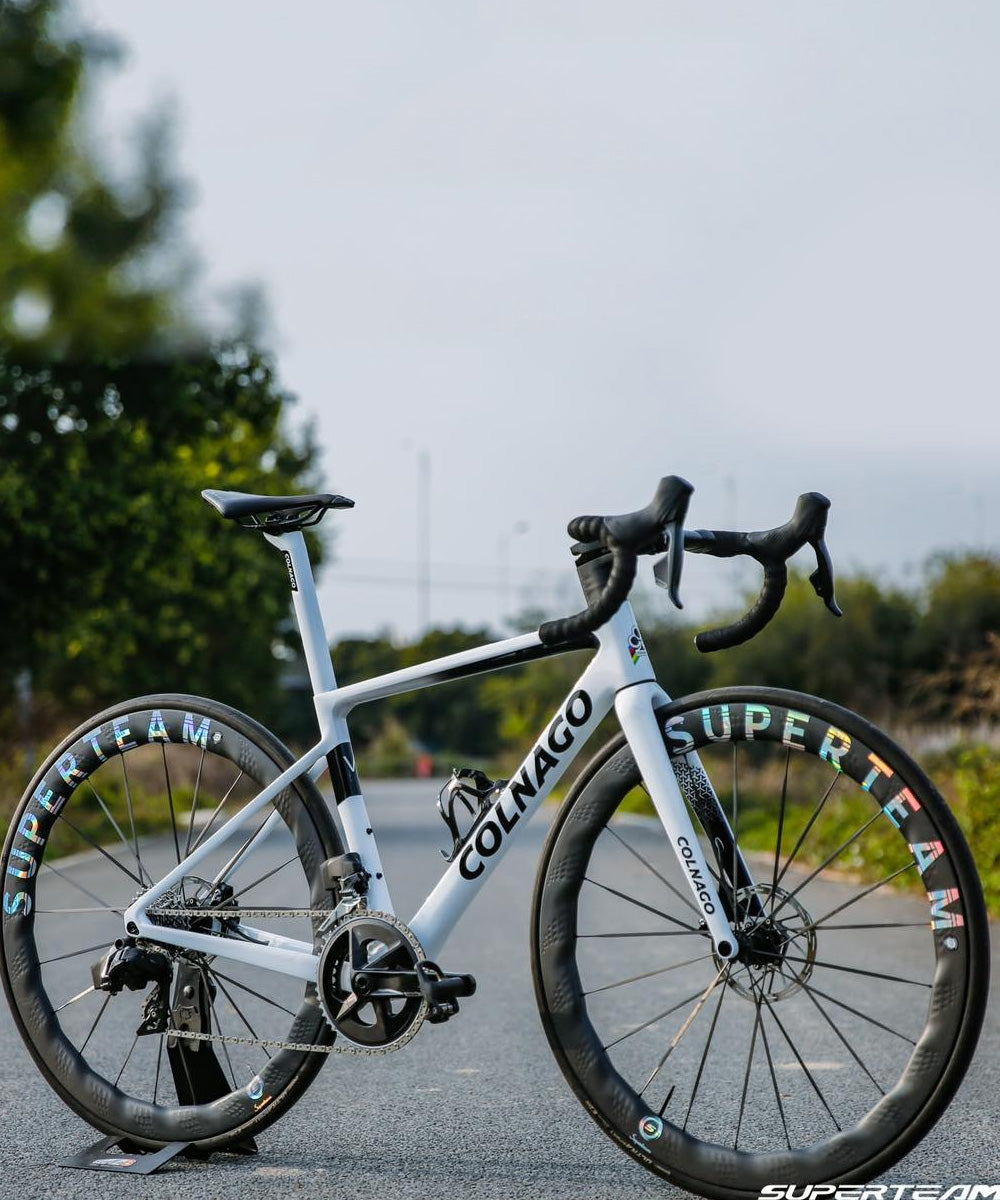
High-speed descending on long alpine roads can amplify imbalance, especially with deep-section carbon rims. Disc wheels and very deep aero wheels are also more sensitive because they carry more mass farther from the center. Tubeless setups with liquid sealant can develop an imbalance if sealant pools unevenly over time.
Track cycling, time trials, and triathlon setups are the disciplines where balance is most likely to make a measurable difference.
The role of valves, sealant, and tires
Valve stems are the most common cause of imbalance. Long metal tubeless valves or valve extenders add concentrated mass at one point on the rim. Tubeless sealant can also collect unevenly if the bike sits unused for long periods.
Tires themselves are rarely perfectly uniform. Heavier sections in the casing or tread can create an imbalance even on a perfectly built wheel.
Can balancing improve comfort or speed?
In theory, a balanced wheel spins more smoothly, which could improve comfort and reduce micro-vibrations at high speed. In practice, the gains for road cyclists are extremely small. There is no clear evidence that wheel balancing improves average speed, power output, or fatigue for typical road riding.
Any perceived improvement is usually limited to feel rather than measurable performance.
How cyclists check their balance at home
Checking wheel balance is simple.
Remove the tire and spin the bare wheel on a truing stand or in the bike frame. If it consistently settles in the same position, that spot is heavier. Repeat the test with the tire mounted to identify whether the imbalance comes from the rim or the tire.
This test is more diagnostic than corrective for most riders.
Should you actually balance your road wheels?
For the majority of road cyclists, wheel balance testing is not necessary. Proper wheel building, correct spoke tension, good tires, and accurate truing matter far more. Spending time on tire pressure optimization and drivetrain efficiency will deliver much greater benefits.
Balancing may be worth considering for deep carbon wheels, disc wheels, or riders who frequently descend at very high speeds and are sensitive to ride feel.
Conclusion
Wheel balance testing sits firmly in the “nice to know” category for road cycling rather than a true necessity. While imbalance exists and can be detected, its impact on real-world road riding is minimal for most cyclists. For everyday training and racing, focusing on wheel quality, tire choice, and maintenance will deliver far more meaningful gains than balancing a wheel that already performs well.