
The new UCI regulations for 2026 are now in effect. Below is a summary of some key changes. While seemingly only relevant to professional riders, these regulations directly impact manufacturers' product design direction.
Handlebars

First, the handlebars. The UCI has focused heavily on this, revising existing rules while introducing new ones.
1. Minimum Total Width Now 400 mm
If you measure the width of the handlebars at their widest point (including the bar tape), it must not be less than 400 mm. This is 50 mm more than last year's 350 mm limit, meaning that those more avant-garde, narrower handlebars used by a minority of professional riders will now be considered violations.
2. Brake Lever Gap Must Exceed 280 mm
This rule states that "the minimum measured distance between the inner ends of the brake levers should be 280 mm," and according to some visual clarifications, this actually refers to the innermost point of the shifter, not the outer edge of the brake lever itself.
In clearer terms, it means the gap between the two shifters at their narrowest point must be 280 mm or more. This is a new rule that largely replaces the UCI rule regarding the permissible tilt angle of the shifters (although the 10° limit still applies).
3. Handlebar drop width must not exceed 65 mm
This rule is slightly more complex in theory, so we'll include the UCI chart below. Simply put, the width of the handlebar drop (left-right direction) must not exceed 65 mm.

This is a new restriction, whereas the restriction for track bike handlebars is 80 mm. This effectively limits riders from using handlebars with excessively large flare angles. However, given the new 280 mm rule mentioned above, they can't use them anyway.
Wheelset Height

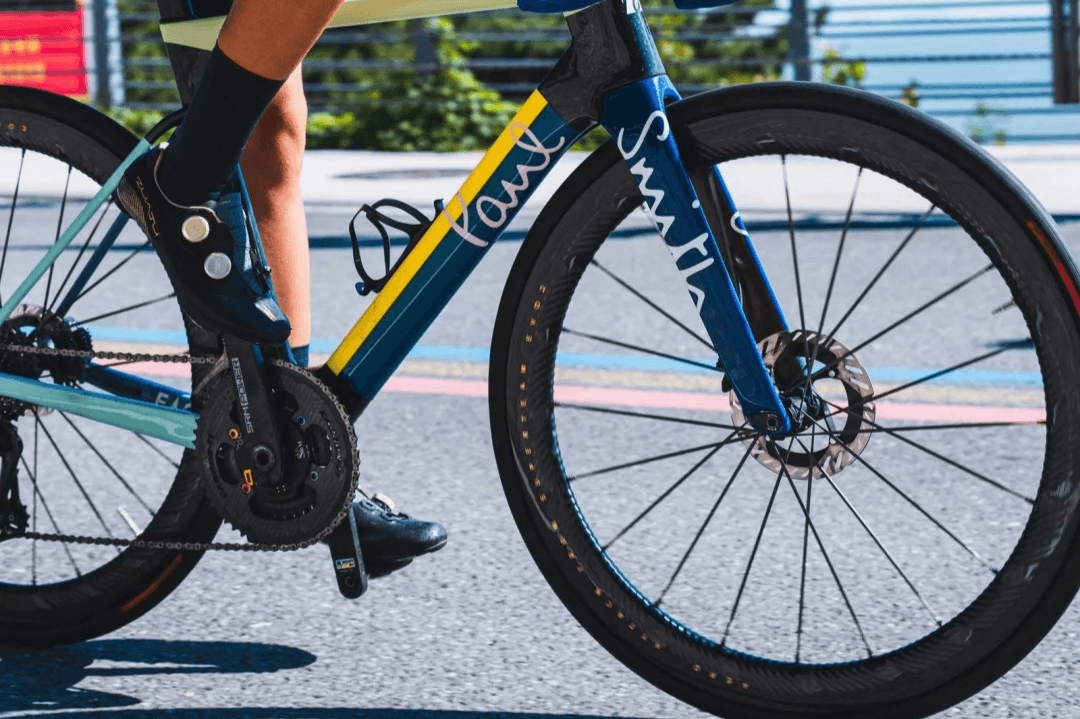
Rim height must not exceed 65 mm, except in time trials.
This rule is quite simple: when measuring rim depth, no point can exceed 65 mm.
This rule also applies to wheelsets with a wavy profile; any point exceeding 65mm is a violation, even if the average or lowest rim height is below 65mm.
However, this rule only applies to mass start events. Higher rim height wheelsets are still permitted in individual and team time trials.
The UCI makes no secret of its intention to find ways to slow riders down and make the sport safer. While not all measures align with this goal, mandating lower rim height wheelsets will have some impact.
New Helmet Classification

Helsets are now divided into 'traditional' or 'time trial' types, with restrictions on their use.
In recent years, there has been an increase in professional riders wearing time trial helmets in road races. This began with the Uno-X team using a modified Sweet Protection Tucker 2Vi helmet (essentially with the visor removed), and a year later, the Wismar-Rental Bikes team popularized it with the Giro Aerohead helmet in a similar manner.
In the 2025 Giro d'Italia, Uden went a step further, using Lazer's Victor time trial helmets with visors for his entire sprint train.
The reason became clear when the CN Labs team headed to the wind tunnel to test over 40 helmets. The three time trial helmets tested took the top three spots, offering approximately 3 watts more power than the best 'aerodynamic' road helmets and 7 watts more power than standard helmets at 40 km/h. In professional races where sprint speeds can approach twice that, the potential gains are enormous.
However, they undeniably looked somewhat comical.
Recognizing the available savings, POC introduced the Procen Air helmet with a front visor and ear covers; Kask introduced the Nirvana helmet, which also partially covers the ears.
Whether for the same reason of slowing down as the wheelset regulations or as a means of maintaining athletic aesthetics, the UCI has also introduced helmet classifications.
The two types of helmets are as follows:


In road racing, time trial helmets are only permitted in Individual Time Trial (ITT) or Team Time Trial (TTT) events.
In track racing, time trial helmets are permitted in all events, although this rule will change in 2027.
Time trial helmets are not permitted in cyclocross.
Frame Design

Fork width must not exceed 115 mm; rear triangle width must not exceed 145 mm.
Another rule, likely stemming from both aesthetic and aerodynamic considerations, announces limits on the maximum width between fork legs and between the rear triangle seat tubes of the frame.
Specifically, for the fork, the distance between the inner sides of the two fork legs must not exceed 115 mm.
At the rear of the bicycle, the distance between the inner sides of the two chainstays must not exceed 145 mm.
For track bike frames, these restrictions only apply to the bottommost part (i.e., the area closest to the axle). This means bikes like the Hope HB.T are currently compliant as long as their wide forks and rear forks taper to the restrictions at the bottommost part, but this will change again in 2027.
Anti-Doping: From January 1, 2026, the use of carbon monoxide as a method to enhance athletic performance will be added to the World Anti-Doping Agency's (WADA) prohibited list.
The agency announced its addition to the prohibited list in September, stating: "Non-diagnostic use of carbon monoxide has been added to a new chapter, M 1.4, as a prohibited method." In its summary of the major changes to the prohibited list, WADA stated, "Under certain conditions, it can increase red blood cell production." Initial media reports about some top professional cycling teams using carbon monoxide rebreathers raised questions about whether they were using the gas to stimulate red blood cell production, but these teams clarified that they only used it to measure blood volume.
In other developments by the World Anti-Doping Agency (WADA), the use of weight-loss drugs (GLP-1 agonists) such as semaglutide and telpoxetine is being monitored, along with narcotics such as codeine and hydrocodone, and stimulants such as caffeine.
Puppy Pose

While the changes are minor, the UCI has added clarification regarding the infamous "puppy pose," where riders place their forearms on the handlebars for a more aerodynamic but less safe position.
Previously, the rule stated: "The forearm is prohibited as a support point on the handlebars, except in time trials." However, given that time trials are sometimes conducted using road bikes (e.g., the mountain time trial stage 13 of the Tour de France), the rule has been revised to increase clarity.
The current rule states: "The forearm is prohibited as a support point on the handlebars, except in time trials, where such support is only permitted on fixed additional time trial extensions."
Coming Soon – UCI Rankings: Points earned in non-road events will soon count towards the World Tour Road Rankings. The UCI team rankings are crucial for teams as they determine which teams qualify for a World Tour license every three years. Starting October 19, 2026, the UCI will include points earned in non-road events in its rankings. However, this only applies to the top 20 riders in a team's rankings, as only these riders are counted in the team rankings.
Points from circuit, mountain bike, cyclocross, and gravel World Championships, as well as final ranking points from major UCI series (World Cup or Nations Cup), "may be accumulated according to a specific points scale (not yet published)." This rule applies to both men's and women's teams; however, women's teams are an exception, with only the top eight riders' points counting towards the team rankings.
Points from multiple events will also count towards the rankings for men's elite and U23 continental teams, but not towards individual UCI rankings.
This could be good news for teams like Q36.5, whose star rider Tom Piedcock will undoubtedly earn points in the XCO (Olympic Cross Country) race, potentially helping them secure World Tour status in 2029.
This could also lead to more riders being allowed to compete in other events and foster more multi-event riders.
Gear Ratio Limitation Test Still Unresolved
When the UCI announced most of the new rules last summer, one proposal remains unimplemented.
Specifically, it's the gear ratio limitation test originally scheduled for the Tour of Guangxi.

According to the UCI, this was another attempt to slow down the peloton, but shortly after the announcement, engineering experts proved it would have no substantial impact on rider speed or safety.
Shortly thereafter, SRAM filed a legal challenge through the Belgian Competition Authority (BCA), arguing that the rule unfairly damaged its reputation because its use of a 10-tooth flywheel made it non-compliant by default.
SRAM soon achieved an initial victory, which in turn meant that the trial was suspended after the BCA implemented "temporary measures."
The UCI has remained silent on the matter since then, so it is unclear whether the idea of a gear ratio limit has been shelved entirely or merely temporarily frozen.


Laisser un commentaire
Tous les commentaires sont modérés avant d'être publiés.
Ce site est protégé par hCaptcha, et la Politique de confidentialité et les Conditions de service de hCaptcha s’appliquent.