
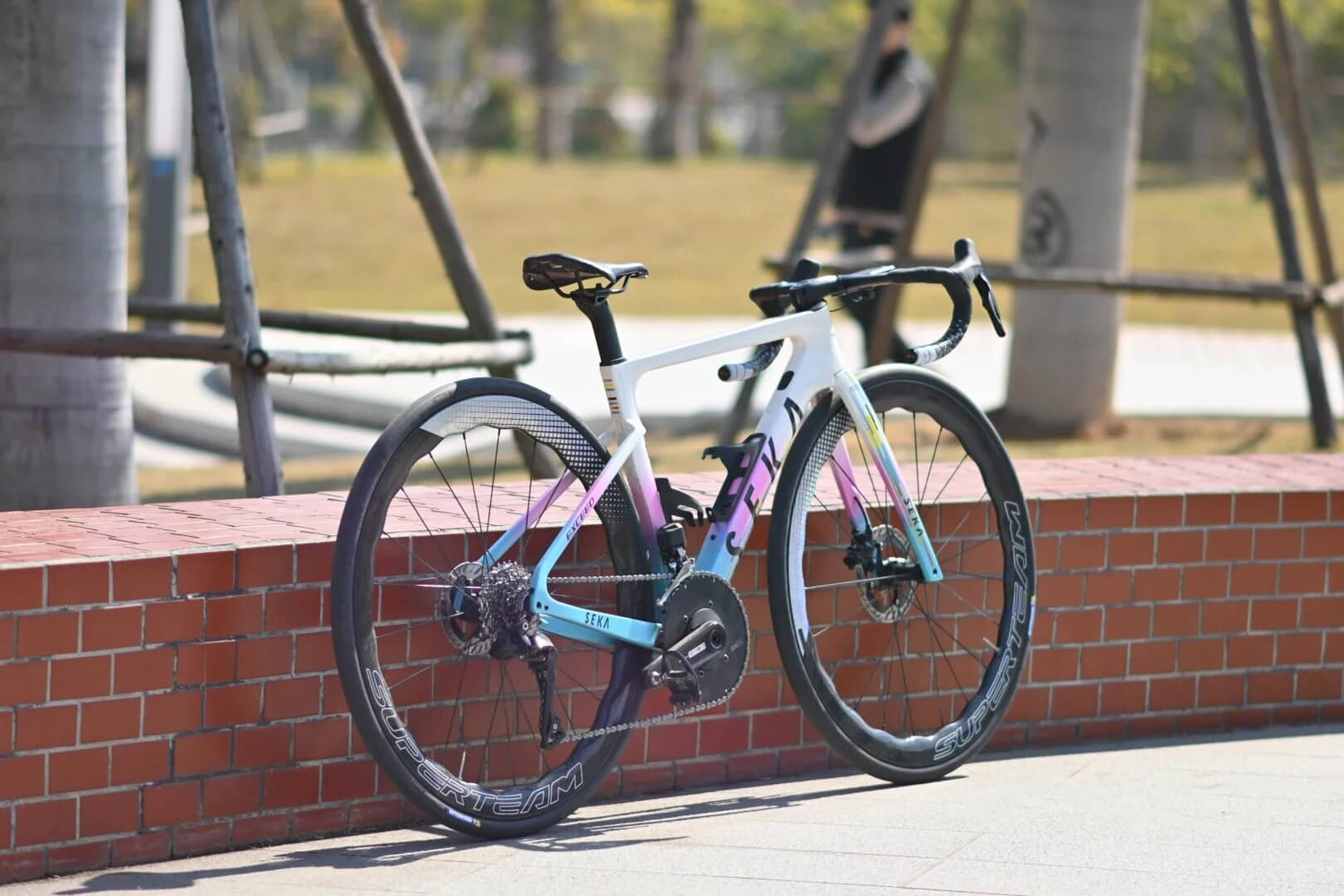
While this article focuses on the basics of tires, a deep understanding of them is a fundamental skill for any cyclist.
The invention of pneumatic tires effectively solved the problem of bumps caused by solid rubber tires, elevating the riding experience to a new level. The air inside the tire acts like a spring, effectively absorbing ground vibrations and providing better grip and traction.
Proper tire pressure can easily enhance your riding experience. Incorrect tire pressure will negatively impact your cycling and increase the risk of punctures and leaks.
How do our tires keep air from leaking out?
If you've never had a tire repaired before, you probably haven't even considered whether there's air inside the tire. (Don't laugh; I've seen many tires that are quite flat, but cyclists are completely unaware.)
Most bicycles use inner tubes: a ring-shaped tube with a valve, installed between the outer tire and the wheel, which can be removed and replaced. A tire provides optimal grip and puncture resistance only when the inner tube is fully inflated.
You may have heard of tubeless tires. These don't require an inner tube and are simply fitted to a special rim. They typically contain a sealant (tire sealant), a liquid that effectively blocks any points where air can escape.
Tubeless systems are very common on mountain bikes and are slowly becoming more prevalent on road bikes. The sealant in tubeless systems seals potential leaks and reduces the risk of "snakebites" caused by low tire pressure: when a tire is too low, the inner tube is pressed against the rim and can burst. Therefore, tubeless systems can operate at lower tire pressures than tubed tires to improve grip and traction, and also prevent "snakebites."
More advanced tires include tubular tires. They're called tubular because they're essentially a tube, with the inner tube sewn inside the outer tire (some models don't have an inner tube). Most people probably won't need one.
Tire Pressure (Tire Pressure)

Inflating tires to the correct pressure is a crucial part of bicycle maintenance.
Running tires with too high or too low pressure can pose potential risks to your bicycle. We'll discuss the correct pressure later; first, let's look at the possible problems.
If the tire pressure is too low, the tire will wear out prematurely. Excessive bending of the sidewall can cause the internal woven layers to crack, eventually leading to bulges or even a blowout.
Low tire pressure increases the likelihood of punctures and can even cause the tire to detach from the rim (internal pressure helps hold the tire in place).

Low tire pressure reduces riding efficiency, making you more likely to experience the "thrill" of a puncture.
With even lower tire pressure, the wheelset may also be damaged. A large impact can cause the rim to dent, potentially requiring rim replacement – a more distressing prospect than a puncture.
Similarly, excessive tire pressure is also risky, causing the tire to detach from the rim and resulting in a puncture. Internal tire pressure helps hold the tire in place, but too much pressure can push it beyond its limits and cause it to detach from the rim.
In terms of handling, low tire pressure causes the tire to wobble from side to side, making the bicycle difficult to control. Excessive tire pressure leads to insufficient grip and excessively sharp bumps, increasing fatigue and affecting your ability to control the bicycle.
Why are my tires flat?
There are two reasons why a tire might be flat: either you have a puncture, or you haven't inflated it in a long time.
If it's a puncture, then repair is necessary…
If it's the latter… actually, all tire systems leak air slowly because they aren't completely airtight. For example, traditional butyl rubber inner tubes hold pressure much longer than lightweight latex inner tubes. Even tubeless systems leak air slowly.
Older inner tubes leak air faster than newer ones. So, if your inner tube has poor airtightness and hasn't been replaced in a long time, you'll have to replace it, especially on older bicycles where the valve stem may no longer be properly sealed.
The only way to check for these problems is to inflate the tire. If everything is normal, that's best. If there's a problem, either you can't inflate it to the correct pressure, or there's a possibility of a tire blowout.
If your tire went flat overnight, it's either because of a small puncture or, as mentioned above, the inner tube is too old and needs to be replaced.
What types of valves are available on our bicycles?
Before inflating your tires, you first need to know about valve types. A valve is a crucial component for maintaining tire pressure, allowing you to inflate (or deflate) your tires.
Schrader valve

Schrader valves are also commonly used in car tires.
Schrader valves are more common on lower-end bicycles, and historically, on mountain bikes as well. You'll also find them on cars.
The valve assembly is a hollow tube with a spring-loaded valve that automatically closes and is screwed inside the hollow tube. The needle inside the valve extends upwards, usually flush with the top of the outer tube. Pressing down the needle releases air.
The dust cap on the Schrader valve is an important part of the design; it helps to completely seal the valve if it's not completely airtight. The dust cap essentially provides a secondary "backup" seal. The valve's spring design is somewhat susceptible to dust and sand contamination, so protection is essential.
Presta Valve

The Presta valve is longer and thinner than the Schrader valve.
You can only find Presta valves on bicycles. Originating from road bikes, the thinner valve stem (6mm compared to the Schrader valve's 8mm) means a smaller valve hole on the rim. (In the past, this made sense for improving rim strength; a larger hole would have made this the weakest part of the rim.
Today, Presta valves are not only found on road bikes but also on many mountain bikes. The valve on the stem doesn't use a spring; instead, it's secured by threads to close. However, when the tire pressure is sufficient to close the valve, it automatically seals itself.
When using a Schrader valve, you need to press down the valve stem pin to release air, but with a Presta valve, you must first loosen the small lock nut. Don't worry about the nut falling off the valve stem, as it's internally secured to the valve to prevent this.
There's a long-standing belief that Presta valves handle high pressure better. However, considering that Schrader valves can withstand hundreds of Psi (much higher than tire pressure), this is likely just a myth.
Presta valves are definitely more delicate than Schrader valves, so the valve core nut is actually quite fragile; it can be bent or even broken. However, if your Presta valve core is replaceable, you can simply replace it with a new one, and it will still work. If, unfortunately, it's disposable, then the inner tube is ruined. So, caution is advised. The good news is that removable valve cores can be removed with ordinary tools. Schrader valve cores, on the other hand, require special tools.
Some Presta valves also have a locking ring to secure the valve stem to the rim. Besides reducing impact with the rim, this also makes inflation easier. However, if you have carbon fiber wheels, it's recommended not to install this for everyday use. Like Schrader valves, Presta valves also have dust covers, but these are not necessary for a seal; they do help keep the valve clean.
Dunlop/Woods Valve/Presta Valve: This is probably the most common type of valve we encountered as children. It has a similar diameter to a Schrader valve and can be inflated using the same nozzle as a Presta valve. These valves are less common now, except on some older commuter bikes.
Tubeless Valve/Nucleo Valve

At first glance, tubeless valves look very similar to Presta valves. Tubeless valves are directly attached to the rim, while Presta valves are directly attached to the inner tube. While Schrader valves do exist, we mostly see Presta valve-type tubeless valves.
How Does an Air Pump Work?
An air pump forces ambient air into the tire. The principle is simple: increase the air pressure inside the pump until it exceeds the pressure inside the tire. This "overpressure" forces air into the tire, increasing tire pressure.
The air pump is essentially a manually operated piston. During the piston's downward stroke, the check valve (which only allows air to flow in one direction) seals the piston chamber, causing the air to be compressed within the pump, increasing the pressure. This pressure increases until it exceeds the tire's internal pressure.
At this point, a second one-way valve allows air to flow from the pressurized pump into the tire. As the piston moves upward, the check valve opens, allowing fresh air to enter the pump, and the process repeats.
To prevent high-pressure gas leakage from the tire, a second check valve at the bottom of the pump closes.
Presta valves typically seal automatically under pressure, but spring-loaded Schrader valves are usually kept open by a pin inside the pump nozzle (meaning no extra effort is needed to overcome the spring pressure during inflation). The pump nozzle, acting as a sealing component connecting the pump and the tire valve, generally comes in two designs: threaded and push-in. Most modern pumps can now support both Schrader and Presta valves.
Generally, tire pumps either have two different types of inflation ports on their nozzles, or they have a single inflation port, often referred to as a "smart nozzle." On larger pumps, the nozzle is usually attached to the hose, while on smaller, mini portable pumps, the nozzle is typically integrated with the pump itself.
Currently, more and more tire pumps are integrating a tire pressure gauge, allowing for more precise tire inflation and pressure checks.
What type of pump do we need?
In my opinion, if you only plan to buy one pump, then a household floor pump is the type you should choose because it's efficient, fast, and easy to use. However, without a doubt, if you want to go for a ride, this is definitely not a good option; an extra mini pump is the best choice in this case.
How to inflate bicycle tires with a pump
First, you need to connect the valve to the tire valve. Remove the valve cap from the tire. Regardless of the type of valve, we've found that pressing down on the valve to release a little air before inflating ensures that the valve won't get stuck with dirt. Then screw the valve onto the tire valve or press it into the valve and secure it.
If your tire is completely flat, installing the valve might be a little difficult because the tire valve will be pushed into the rim. In this case, you just need to press and hold the valve from the outside of the tire to secure it to the tire valve.
The locking ring on the Presta French valve also helps prevent the inner tube from moving when flat.
The connection between the air pump nozzle and the tire valve should be airtight. A small amount of leakage during nozzle installation is normal, but it shouldn't persist for long. If this happens, remove the nozzle and reinstall it. If the problem persists, the rubber seal on the nozzle may be worn or damaged.
Remember to be gentle when securing the tire valves, as they are very small. This is especially important when using a mini pump without a hose. Make sure to hold the spokes or the tire to support the nozzle and prevent it from tilting and damaging the tire valve.
When you start pumping air, always use the full stroke of the pump. Most of the stroke is used to compress the air before it's forced into the tire. If you don't use the full stroke, air won't flow out from the bottom of the pump because you need to create pressure higher than the tire. Doing so will only waste time or effort.
When using a floor pump, don't just use your arm; using your body weight to press down will make the pumping process easier.
Sometimes, an air pump can't maintain pressure, especially after the tire is fully inflated. This is particularly true for older pumps, which may be because the seals inside the pump need replacing.
During inflation, the first few pumps should be quick and forceful to rapidly build pressure inside the tire. This allows the pressure to push against the valve stem seal from the back of the tire, which helps stabilize the tire pressure later. Then continue pumping until the correct tire pressure is achieved.
When removing the valve stem from the tire valve, you'll usually hear a hissing sound. This is generally from airflow in the hose between the pump and the valve stem, not from the tire itself.
Factors to Consider for Tubeless (Noviceless) Systems
If you have a tubeless system or have applied sealant to your inner tube, following these steps before inflating can prevent your pump from clogging.
Rotate the wheel so the valve stem is at the bottom and let it sit for a few minutes to allow the sealant to dissipate. Then rotate the wheel so the valve stem is at the top of the wheel rim before inflating the tire. Similarly, the same applies when deflating tires; this prevents tire sealant from spraying everywhere.
What pressure (psi) should our bicycle tires withstand?
Correct tire pressure is always a highly controversial topic, but there are certainly some data that can provide a reference.
As a general rule, we often look at how the tires feel when weighed during a ride. If your tire is significantly flattened, it means the tire pressure is too low. While lower tire pressure can provide some shock absorption, it can cause "snakebite" punctures in the inner tube when encountering potholes.
Additionally, most tires have minimum and maximum tire pressure ranges printed on the sidewall. It is recommended not to go below or above these limits, as manufacturers have a reason for this. While exceeding them slightly won't cause an immediate blowout, it's best to avoid it.
Traction
For mountain bikes, the goal is more specific: to improve traction, cornering, and shock absorption. As a general principle, riders will choose the lowest possible tire pressure, but the standard is to prevent tire creep or rim damage under cornering loads. Rolling Resistance
For road bikes, it gets a bit more complicated because rolling resistance is a major consideration in addition to traction and comfort. Contrary to many people's assumptions, new data suggests that higher tire pressure and narrower tires don't necessarily mean faster riding.
Higher tire pressure and narrower tires have proven to offer little in terms of shock absorption and energy retention, except on very smooth surfaces. Instead, they cause you to bounce and slow you down when the road is bumpy. Lower tire pressure, on the other hand, provides more comfort and a smoother ride.
A more comprehensive study, conducted by Frank Berto, visualizes tire pressure graphically. The test determined that 20% tire compression is the optimal balance point. (The amount of tire compression under load, measured from the ground to the rim edge.)
Incidentally, some manufacturers recommend using the tire-to-ground contact area to suggest tire pressure, although this figure is still somewhat controversial.

This table does provide a very good reference for tire pressure. The weight on the icon shows the load on a single tire. Generally, the weight distribution is 40% on the front and 60% on the rear. You can use this icon to estimate the appropriate tire pressure.
How often should we inflate our tires?

It is recommended to check tire pressure before each ride. Usually, you can simply squeeze the tire by hand to check the pressure. Does that seem inaccurate? You'll quickly feel the tire pressure and accurately determine if it needs inflating.
If you have very high standards or don't like this "operation," then you'll need a pressure gauge (such as the Arred AG-01).

It can read tire pressure very accurately. This is especially useful for mountain bikes, as the pressure of a few points (PIS) can significantly affect handling. It also applies to road bikes, allowing you to find the right tire pressure for you.
A perfect riding experience starts with the correct inflation and tire pressure, making your rides much more enjoyable.


Laisser un commentaire
Tous les commentaires sont modérés avant d'être publiés.
Ce site est protégé par hCaptcha, et la Politique de confidentialité et les Conditions de service de hCaptcha s’appliquent.