


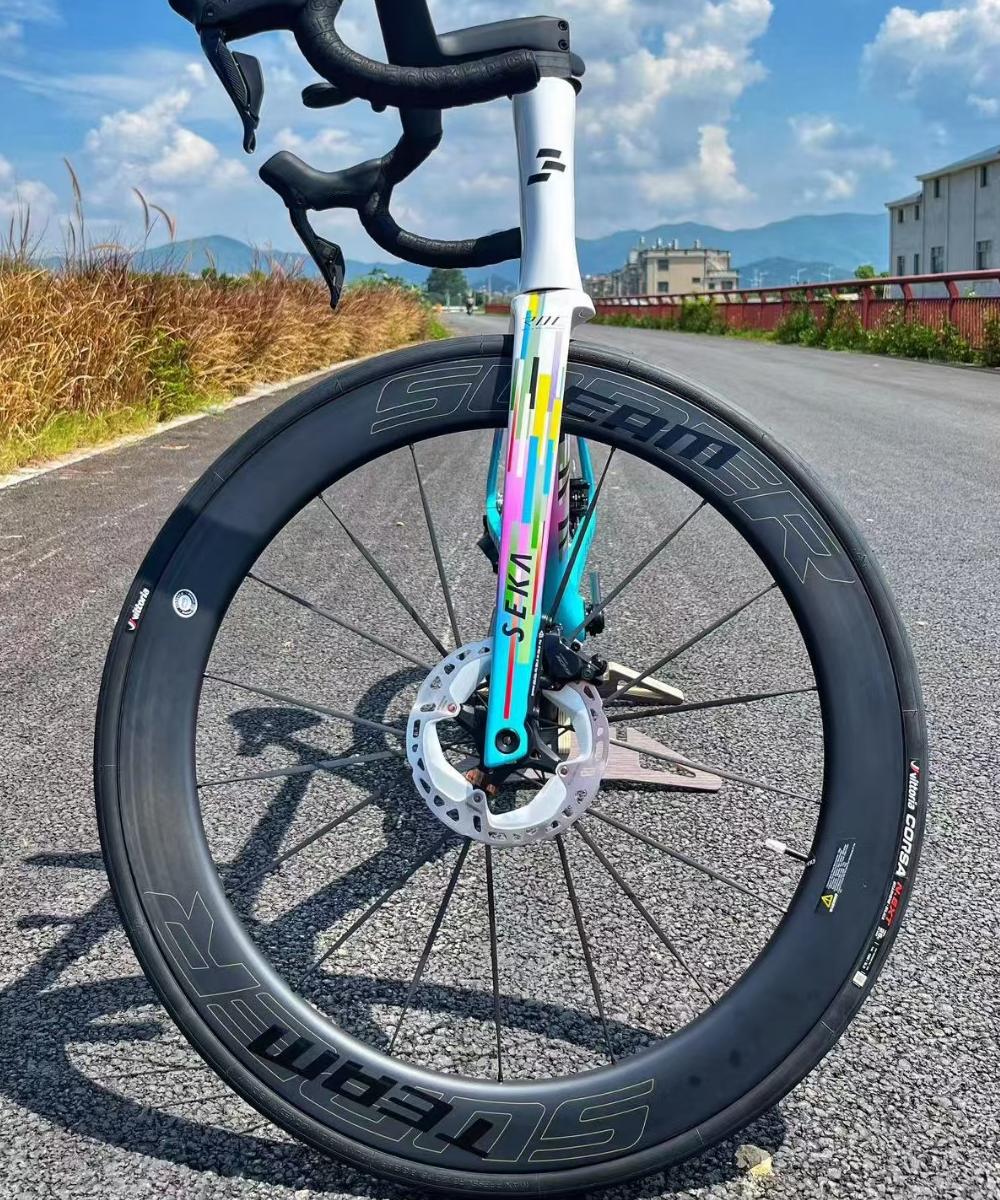
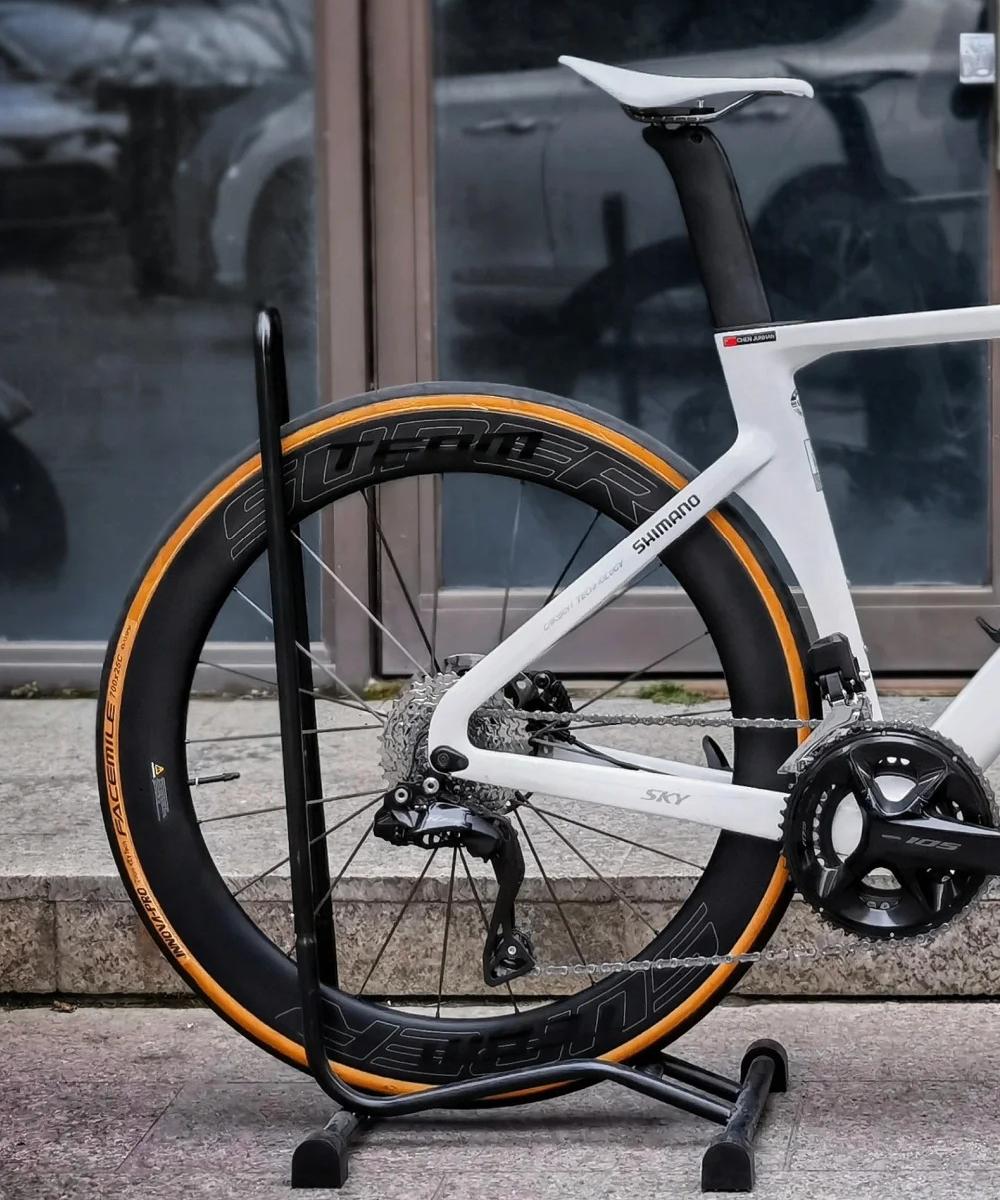
Bike Speed Wobble Causes: Wheels, Tires, Frame and Fork
A rider experiences a violent wobble at 40 mph and immediately blames the wheels.
That is understandable.
It is also often too early.
Bike speed wobble can involve the frame, fork, steering geometry, wheels, tires, rider position, and load distribution. A wheelset may be involved, but it is only one part of the system.
The better way to diagnose the problem is to work from simple mechanical checks toward more complex dynamic explanations.
This prevents expensive guesswork.
Start With the Front End
If the wobble involves the handlebars, inspect the steering system first.
The headset deserves particular attention.
Cycling UK recommends checking for free play by applying the front brake and rocking the bike back and forth. It also says the handlebars should turn smoothly without roughness or notching.
This is an easy check.
If you feel movement where there should not be any, do not continue high-speed testing.
A worn or poorly adjusted headset can affect steering.
The same applies if the steering feels unusually tight.
The front end should turn smoothly without excessive play.
Check Wheel Installation Before Blaming the Wheel
A wheel that is not correctly secured is a more immediate concern than theoretical aerodynamic behavior.
Check the front axle or quick-release.
Make sure it is correctly installed according to the manufacturer's instructions.
Then spin the wheel.
Listen.
Watch the rim.
Look for obvious lateral movement.
Cycling UK's technical advice specifically recommends checking front-wheel installation and wheel bearings when investigating shimmy.
A wheel that is visibly damaged or loose should not be used for high-speed testing.
Wheel Trueness and Dish Matter
A wheel does not need to be perfectly motionless to be usable.
But obvious lateral or radial deviations deserve attention.
Park Tool separates wheel trueness into lateral and radial components. Lateral trueness describes side-to-side deviation, while radial trueness concerns how round the wheel is.
Wheel centering matters as well.
Park Tool notes that bicycle wheels are designed to sit centered relative to the frame or fork, and that an improperly dished wheel can negatively affect handling.
For a high-speed road bike, these checks are worth performing before assuming the problem is caused by frame design.
Tire Condition Is Easy to Ignore
A tire is the only component directly connecting the bicycle to the road.
Yet riders often inspect the wheel before inspecting the tire.
Check:
Tire pressure
Tread wear
Sidewall damage
Uneven wear
Bead seating
Tire width
Tire installation
A damaged or improperly seated tire can change how the bicycle behaves.
This is particularly important after changing from one tire model to another.
The same wheelset can feel different with a different tire construction, width, or pressure.
That does not automatically mean the new tire is unsafe.
It means the entire setup has changed.
Tire Pressure Can Change Handling
A tire is not simply an air-filled cushion.
Its pressure changes casing deformation and the shape of the contact patch.
That affects steering feel.
This is one reason tire pressure should be evaluated when troubleshooting a high-speed handling problem.
Cycling UK recommends regular tire-pressure checks as part of routine bicycle safety.
Do not make dramatic pressure changes solely to eliminate wobble.
Instead, return to a sensible pressure range recommended for the tire and rim combination.
Then test under controlled conditions.
Are Deep-Section Carbon Wheels the Problem?
This question comes up frequently.
The honest answer is: sometimes a wheel change can alter handling, but that does not prove the wheel is causing a speed wobble.
A deeper front rim can change the bicycle's aerodynamic response to crosswinds.
Wheel stiffness also changes.
Rotating mass changes.
Tire compatibility may change.
Even the tire pressure may change because the new rim has a different internal width.
All of these variables can alter how the bicycle feels.
That is different from saying “deep carbon rims cause speed wobble.”
There is not enough evidence to make that universal claim.
A better way to test a new wheelset
If a wobble appears after a wheel upgrade, compare:
Old wheelset → same tire → same pressure → familiar descent
Then:
New wheelset → same tire → same pressure → same descent
Change only one variable at a time.
This is much more informative than changing wheels, tires, and pressure simultaneously.
Frame and Fork Alignment Should Not Be Ignored
A bicycle can have a perfectly true wheel and still handle poorly if there is an alignment or structural problem.
After a crash, inspect the fork and frame carefully.
Look for:
Visible damage
Unusual tire clearance
Wheel not sitting centrally
Steering that feels different
New noises
Changes in handling
If there is any suspicion of structural damage, professional inspection is appropriate.
Do not attempt to diagnose carbon structural integrity from appearance alone.
A carbon component can require more detailed assessment after an impact.
Steering Geometry Changes Stability
A road bike's handling is influenced by geometry.
Head angle, fork offset, trail and wheelbase all affect steering behavior.
This is one reason two bicycles with similar wheel sizes can feel completely different on a descent.
Cycling UK's technical discussion identifies steering geometry as one factor in bicycle shimmy behavior.
Geometry is not something a rider can usually change with a five-minute adjustment.
That is useful to remember.
If a particular bicycle has a known handling characteristic, changing tire pressure may modify the feel but will not turn it into a completely different frame.
Rider Weight and Luggage Can Change the System
The bicycle is only part of the mass.
The rider may weigh several times more than the frame.
Add a saddle bag, frame bag, bottles, or touring luggage and the distribution changes again.
Cycling UK's technical material notes that shimmy characteristics can vary with rider and luggage mass and its arrangement.
This explains an interesting real-world observation.
A bicycle can feel stable on a solo ride and behave differently when heavily loaded.
That does not necessarily mean a component suddenly failed.
The complete dynamic system has changed.
Why Some Bikes Never Seem to Wobble
You may know riders who descend at high speed without ever reporting shimmy.
That does not prove their bikes are mechanically superior.
They may simply operate outside the speed and loading conditions that excite the bicycle's particular oscillation.
BikeRadar notes that speed wobble is a complex phenomenon and that some bicycles may never exhibit an obvious wobble under normal riding.
The absence of a wobble on one bicycle tells you little about another.
That is why online claims such as “all bikes wobble above X mph” should be treated cautiously.
A Practical Diagnostic Sequence
If you experience repeated high-speed wobble, use this order.
Step 1: Stop high-speed testing
Do not repeatedly recreate the problem.
Step 2: Check the front end
Inspect:
Headset
Fork
Stem
Handlebar
Front axle
Step 3: Check the wheel
Inspect:
Trueness
Bearings
Rim
Hub
Wheel centering
Step 4: Check the tire
Inspect:
Pressure
Bead
Casing
Tread
Sidewalls
Step 5: Review recent changes
Ask whether you recently changed:
Wheelset
Tire
Tire width
Tire pressure
Handlebar
Stem
Fork
Luggage
Step 6: Get professional inspection if necessary
If the problem persists or there is any suspicion of structural damage, have the bicycle inspected before another high-speed descent.
This sequence is deliberately conservative.
The cost of inspection is small compared with the consequences of ignoring a mechanical problem.
Do Not Confuse Wheel Wobble With Speed Wobble
This distinction is especially useful for bicycle websites discussing wheelsets.
A wheel that visibly moves from side to side on a truing stand has a mechanical alignment issue.
A bicycle that begins oscillating only while descending at a particular speed has a dynamic handling issue.
They can coexist.
But they are not the same thing.
This distinction also prevents misleading product claims.
A wheelset manufacturer should not promise that a particular rim depth “eliminates speed wobble.”
There are too many variables.
A more credible approach is to discuss rim width, tire compatibility, wheel stiffness, weight, and intended use while acknowledging that complete bicycle handling depends on the entire system.
Final Thoughts
The most useful way to understand bike speed wobble causes is to stop searching for one guilty component.
Check the simple things first.
Headset.
Axle.
Wheel.
Tire.
Pressure.
Then consider geometry, load distribution, and rider position.
A wheelset can influence handling, but it does not exist independently from the frame, fork, tire, and rider.
If your bicycle develops a repeated high-speed wobble, treat it as a genuine handling issue rather than a characteristic to simply “get used to.”
That approach is slower than blaming one component.
It is also much more useful.
FAQ
Q1: What are the most common bike speed wobble causes?
Possible factors include steering geometry, frame and fork characteristics, wheel condition, tire pressure, rider position, load distribution, and mechanical problems such as headset or bearing play.
Q2: Can a bad wheel cause a bike to wobble at high speed?
A damaged, poorly installed, or significantly out-of-true wheel can affect handling. However, a true speed wobble is a more complex dynamic phenomenon and should not automatically be blamed on wheel trueness.
Q3: Can deep-section carbon wheels cause road bike speed wobble?
A deeper wheel can change steering feel and crosswind response, but deep carbon wheels do not universally cause speed wobble. The tire, frame, fork, pressure, and rider all matter.
Q4: Can a loose headset cause bicycle shimmy?
Headset play can compromise steering and should be corrected. It is one of the mechanical checks recommended when investigating high-speed handling problems.
Q5: Why does my bike wobble only at a certain speed?
A bicycle can have speed-dependent dynamic behavior. A particular combination of speed, geometry, load, rider position,n and system stiffness can make an oscillation more noticeable at a specific range.