
Introduction: Many cyclists, especially beginners, are obsessed with high-click hubs and high-density ratchet wheels, finding the ratchet sound irresistible. Manufacturers have been making mountain bike ratchet systems increasingly powerful, with ever-higher click counts and louder ratchets. But is this really a good thing?

Engagement Angle: Before we begin, let me briefly explain what the engagement angle is: When the spacing between each tooth on the freewheel is converted into a circumferential angle, we get the key parameter affecting riding responsiveness: the engagement angle. 360° divided by the number of ratchet teeth equals. For example, in a 36-tooth ratchet system, the engagement angle is 360° ÷ 36 = 10°. This means that for every 10° rotation of the freehub body, the pawl will "click" to complete one engagement, regardless of whether it's a ratchet-pawl structure or a DT ratchet ring structure.
This simple division formula affects multiple parameters, including pedal travel, pedal return, and crouch. Is there an optimal bite angle? What bite angle is more suitable for different types of bikes? How can we find a balance between high pedal engagement and its negative impacts? Let's explore these questions below.
Backlash

Understanding backlash is easy when combined with the bite angle. Imagine: when you suddenly pedal hard, the crank needs to rotate a certain angle to engage the ratchet in the freewheel. Before engagement, the crank's unused travel is the backlash. The formula shows three variables affecting backlash:
Backlash = 2π × Crank length × (Bite angle / 360) × (Cassette teeth / Chainring teeth).

The formula shows that backlash is related to crank length, bite angle, and gear ratio.
However, in reality, crank length is a matter of personal preference and is not easily adjusted once determined. The cassette and chainring combination is adjusted based on personal habits and riding conditions. Therefore, the most constant factor affecting the chainring engagement angle is the hub's engagement angle.

[The different colored lines in the image above represent hubs with different response angles, from 3° to 20°. The vertical axis represents the distance the crank travels, and the horizontal axis represents the gear ratio (e.g., 1 means the chainring and cassette have the same number of teeth). This clearly shows the impact of different hub engagement angles and gear ratios on the chainring engagement distance.] For example, with a 170mm crank paired with a 32T cassette and 32T chainring, a 10° engagement angle will produce approximately 29mm of free travel, equivalent to 10° of pedal play. This value will be amplified into a noticeable power gap during climbs with a high gear ratio.

[The colors in the image above again represent different hub engagement angles. The vertical axis represents the distance the crank travels, and the horizontal axis represents a fixed gear ratio. This clearly shows the chainring response under different combinations.] For example, using a common 52T cassette, with other specifications unchanged, the chainring travel will reach 49mm.
Another example is using a 32T cassette with a 32T chainring, but reducing the bite angle to 4° (e.g., the 90 bite points of a DT DEG hub), the chainring travel can be reduced to approximately 11mm. (A significant improvement compared to 29mm at 10°.)

[Travel is also related to gear ratio: the fan-shaped area represents the relationship between angle and curvature. At the same angle, a larger cassette results in more teeth being rotated, thus increasing the chainring travel.]
Therefore, a higher-density ratchet structure does indeed have a significant performance advantage. This is a common marketing tactic used by many manufacturers to promote high-density, high-click hubs. They use high density to achieve faster power delivery. But what if the situation is more complex?
Pedale Kickback on a full-tail bicycle
However, mechanical ingenuity often comes at a price. When the rear shock absorber is compressed on a full-suspension motorcycle, the distance of the virtual swingarm changes. This change in distance between the bottom bracket and the rear axle pulls on the chain. If the ratchet system is engaged at this time, the chain tension forces the crank to rotate in the opposite direction—this is the pedal rebound often mentioned on softtail motorcycles.

Assuming a 32x14 gear ratio causes shock absorber compression resulting in a 3° crankback, the ratchet angle, calculated using the formula, is 3° × (32/14) = 6.8°.
Under this assumption, when the freehub engagement angle is infinitely large, there is a high probability of pedal rebound. Conversely, if there is no clutch mechanism within the freehub and the freehub is freely selectable, pedal rebound will definitely not occur.
Under this assumption, when the engagement angle is ≤6.8°, the ratchet will inevitably lock in a certain tooth slot, converting chain tension into pedal rebound force; conversely, if the engagement angle is >6.8°, the ratchet has room to rotate freely to release the tension.
Conclusion: Fewer ratchet engagement points reduce the likelihood of pedal rebound.
More ratchet engagement points increase the likelihood of pedal rebound.
The impact of braking on pedal rebound

Braking action exacerbates pedal rebound. At the moment the rear wheel locks, the drivetrain is forced to bear the full chain tension. This is also why downhill riders prefer large-angle engagement systems. The e*thirteen Sidekick hub even offers an adjustable deadband of up to 18°, extending the ratchet-free travel to provide the shock absorber with millisecond-level buffer time.

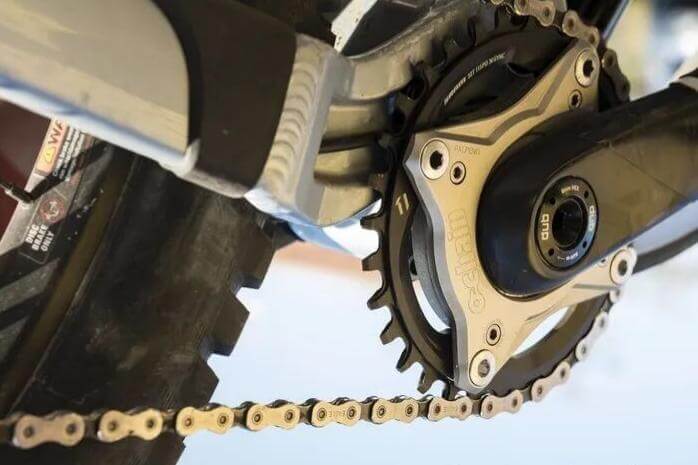
Faced with this dilemma, the most popular aftermarket parts are the O-Chain chainring and the newly released e*thirteen Sidekick clutch hub. The O-Chain Spider inserts a dual-spring system between the crank and sprocket, and the 12° rotational buffer space acts like another clutch mechanism for the drivetrain: a small coil spring handles daily reset, while the elastic bushing absorbs pedal rebound under severe impact.

The e*thirteen Sidekick's design is even more aggressive—its patented pushrod pawl can fully retract during coasting, offering three adjustable deadbands: 12°, 15°, and 18°.

E*thirteen engineers stated that in intense racing, if the engagement angle is only 1°, the hub will engage more than 1000 times per second when gliding at 25 km/h, resulting in noticeable pedal rebound and poor suspension performance.

Choosing the engagement angle is essentially a trade-off, not an absolute one. XC-style bikes, which prioritize precise handling, tend to use hubs with more extreme responsiveness, at the cost of faster ratchet wear and increased gliding resistance; Enduro bikes compromise in the 6-10° range, trading slightly longer free travel for greater shock absorber sensitivity; Downhill bikes embrace the "duller" 12-18° range, since absorbing 10% more impact during downhill racing is far more important than reducing a few millimeters of free travel. There's no single right answer to this choice, just as DT Swiss offers 18-tooth, 36-tooth, 54-tooth, and DEG-spec 90-tooth ratchet systems—the former is suitable for those seeking a crisp, responsive feel at maximum speeds, while the latter is geared towards models and riders who prefer precise handling.

The next time you hear the ratchet's click, consider its meaning beyond simply aiming for a high-octane look: each "click" is both the point of ratchet engagement and a benchmark drawn by engineers between efficiency, durability, and handling.


Laisser un commentaire
Tous les commentaires sont modérés avant d'être publiés.
Ce site est protégé par hCaptcha, et la Politique de confidentialité et les Conditions de service de hCaptcha s’appliquent.