
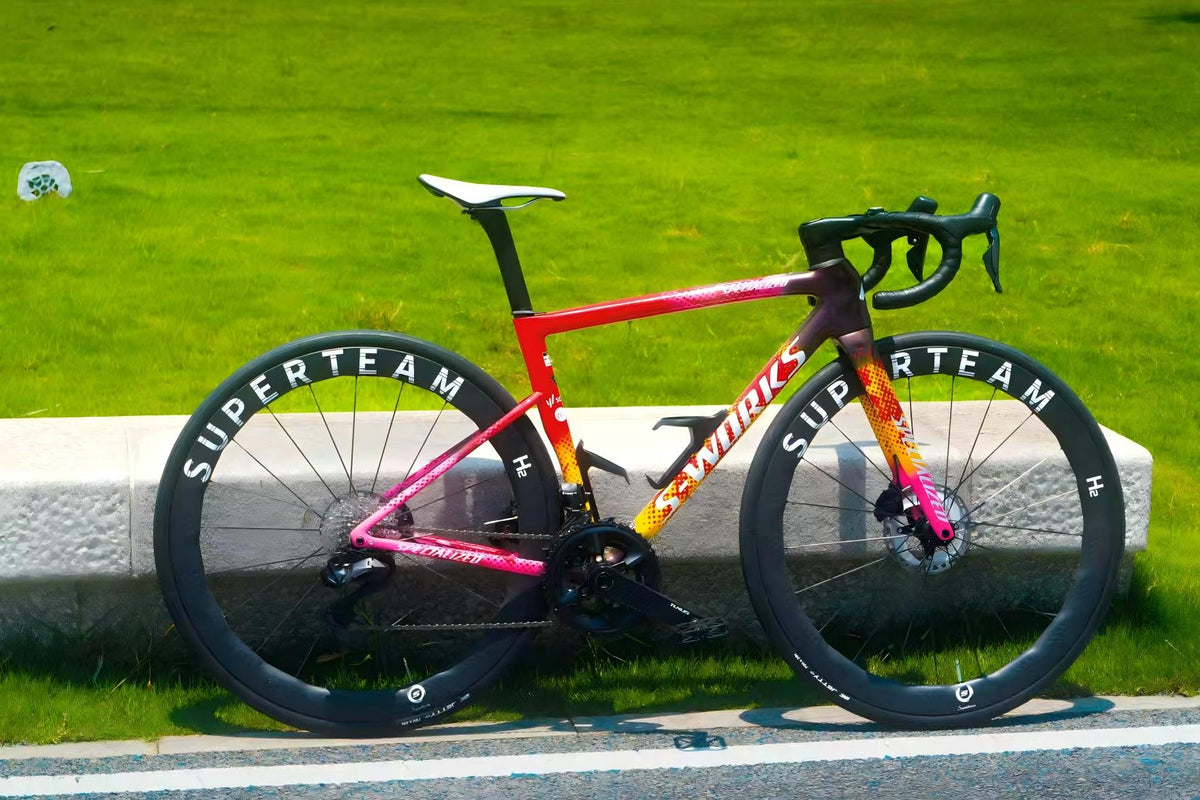
Basic bike repair is an essential skill for every cyclist.
Most riders have likely encountered unexpected issues while out on a ride. The most common problems include a dropped chain, a flat tire, brake failure, or imprecise gear shifting.
Fortunately, these issues can often be resolved quickly on your own. This guide will explain how to prevent such problems and provide simple methods for fixing them.
Ⅰ. Dropped Chain
A dropped chain is a common nightmare for beginners. It simply means the chain has slipped off the gear teeth and fallen to the inside or outside of the cassette (rear gears) or the chainring (front gears).
If this happens, do not force the pedals or pull at the chain haphazardly—doing so may cause it to become even more tightly wedged. Instead, observe where the chain has fallen, free it, and place it back onto the nearest gear or chainring. It’s that simple! However, if your chain drops frequently, the limit screws on your derailleurs may need adjustment; consider asking a local bike shop to take a look.

Ⅱ. Flat Tire
Flat tires are usually caused by sharp objects puncturing the tube. To handle this on the road, you will need a bike pump, tire levers, and a spare inner tube.
1. Insert a tire lever under the edge of the tire and hook it onto a spoke. Use a second tire lever to continue prying the edge of the tire off the rim.

2. Remove the inner tube, starting from the side opposite the valve stem; this makes it easier to pull out without damaging the tube.

3. Inflate the inner tube to locate the puncture. Check the corresponding spot on the outer tire for any sharp objects (like glass or thorns) and remove them to prevent another puncture.

4. Insert a new (or patched) inner tube, then use both hands to push the edge of the tire back onto the rim. Finally, run your hands along the tire to ensure the inner tube is completely tucked inside and not pinched.

5. Inflate the tire to the correct pressure to complete the tire-changing process.
III. Brake Failure
Sometimes, it may feel like the brakes aren't stopping the bike effectively; this is usually caused by excessive brake clearance. It is recommended to check this before setting off to ensure your own safety.
1. If the brake clearance is too large, it should be adjusted to the proper tension.

2. Loosen the fixing bolt, hold the brake caliper in position while pulling the inner cable taut, and then retighten the bolt to complete the adjustment.

IV. Inaccurate Shifting
Inaccurate shifting is often characterized by a "clattering" (clicking) noise or a sluggish response, where there is a noticeable delay when shifting gears up or down. This is typically just a matter of the shift cable tension being slightly off—it can easily be fixed using the barrel adjuster (fine-tuning screw)!
1. If the chain fails to shift from a smaller chainring/cog to a larger one, or if the shift is too slow, simply turn the barrel adjuster counter-clockwise to resolve the issue.
2. If the chain fails to shift from a larger chainring/cog to a smaller one, or if the shift is too slow, turn the barrel adjuster clockwise.


Laisser un commentaire
Tous les commentaires sont modérés avant d'être publiés.
Ce site est protégé par hCaptcha, et la Politique de confidentialité et les Conditions de service de hCaptcha s’appliquent.