


Bike Speed Wobble on Descents: How to Prevent It
A fast descent should not feel like a fight with the handlebars.
If the front of the bicycle starts oscillating, the natural reaction is often to grip harder. That reaction can make the situation harder to manage because tense arms can transmit more unwanted movement into the steering system.
A bike speed wobble on descents has several possible causes, and prevention starts before the descent begins.
The most useful approach is a combination of mechanical inspection, sensible tire setup, controlled body position, and speed management.
There is no single trick that guarantees a wobble will never occur.
There are, however, ways to reduce avoidable risk.
Start With the Bicycle Before the Descent
A high-speed descent is a poor place to discover loose headset bearings.
Before riding fast, check the front end.
Cycling UK recommends checking the headset for free play and confirming that the steering turns smoothly. A loose or damaged headset can impair handling.
Apply the front brake while the bicycle is stationary.
Rock the bike gently forward and backward.
If you can feel movement around the headset, investigate it.
Then lift the front wheel and turn the handlebars.
They should move smoothly.
A rough or notchy steering bearing deserves attention before a fast descent.
Check the front wheel
Make sure the axle or quick-release system is correctly secured.
Spin the wheel.
Look for lateral movement.
Check for unusual noises.
Cycling UK specifically recommends checking wheel bearings and front-wheel installation when investigating shimmy.
This is basic maintenance, but it matters.
Tire Pressure Is Part of Handling
Tire pressure is not only about puncture protection.
It affects how the tire deforms, how large the contact patch becomes, and how the bicycle responds to road inputs.
There is no universal pressure that makes every road bike stable.
The correct pressure depends on tire width, rider mass, rim width, tire construction, road surface, and manufacturer limits.
What matters is consistency.
Do not start a fast descent with a tire that has slowly lost pressure overnight.
Cycling UK recommends checking tire pressure as part of routine bicycle safety checks.
If you recently changed tire size or wheelset, re-evaluate your pressure rather than automatically using your old number.
Your Hands Should Control the Bike, Not Fight It
One of the most common descending mistakes is the death grip.
When a rider feels nervous, the hands tighten.
The shoulders rise.
The elbows lock.
Every road impact is then transmitted directly through the arms.
BikeRadar recommends consciously relaxing the upper body during fast descents. It notes that a stiff body can transmit bumps to the bicycle and make control more difficult.
Relaxed does not mean passive.
Keep a secure grip.
Keep your fingers ready for the brakes.
Allow the elbows and shoulders to absorb small movements rather than forcing the handlebars to remain absolutely motionless.

Body Position Matters More Than Many Riders Expect
On a road descent, the rider's position changes the load on the wheels.
BikeRadar recommends a relaxed posture, looking ahead and using the drops with fingers covering the brake levers when descending.
The exact position should still suit the rider and bicycle.
The important principle is stability.
Avoid sudden movements.
Avoid constantly shifting from left to right.
Keep your eyes well ahead so that steering inputs are smooth rather than reactive.
If the road becomes rough, allow your legs and arms to absorb some of the movement.
Brake Before the Corner
One useful descending habit is to control speed before entering a corner rather than trying to make a large speed correction halfway through it.
BikeRadar's descending guidance recommends braking smoothly and progressively, while Cycling UK's shimmy advice suggests avoiding trail-braking where possible when dealing with speed wobble.
This matters because braking and steering simultaneously can complicate the behavior of the bicycle.
A better sequence is often:
Brake → reduce speed → release or ease braking → steer through the corner.
This is not an absolute rule for every riding situation.
It is a useful baseline for riders who are still developing descending technique.
What If the Wobble Starts?
This is the part most riders actually want to know.
If you feel the handlebars beginning to oscillate, do not deliberately accelerate to see whether it gets better.
Reduce speed in a controlled manner.
Avoid sudden steering inputs.
Keep your body relatively calm.
Cycling UK's technical guidance notes that pressing a knee against the top tube is commonly reported to help damp the oscillation.
Some riders also use both thighs against the frame while standing slightly or unweighting the saddle. BikeRadar discusses standing and changing body contact as one possible way of reducing the oscillation.
The key idea is controlled damping, not panic.
What you should not do
Avoid:
Jerking the handlebars
Making sudden steering corrections
Accelerating into the wobble
Abruptly grabbing the front brake
Looking directly at the front wheel
Continuing a high-speed descent without inspecting the bike afterward
The safest response depends on the severity and road conditions.
If you cannot control the bicycle confidently, reducing speed and finding a safe place to stop is more important than preserving momentum.
Why Hard Braking Can Be a Problem
Braking is necessary.
But abrupt braking while the bicycle is already oscillating can create another layer of instability.
This is one reason experienced descending advice emphasizes smooth brake application.
On loose surfaces, BikeRadar recommends using both brakes progressively and controlling speed before traction becomes limited.
For road riding, the same broad principle applies: braking should be deliberate rather than reactive.
If a wobble occurs on a straight road, the rider has more room to reduce speed smoothly.
If it occurs while cornering, the situation becomes more complicated.
That is exactly why speed management before the corner matters.
Crosswinds Can Feel Like a Wobble
Not every movement of a bicycle is a shimmy.
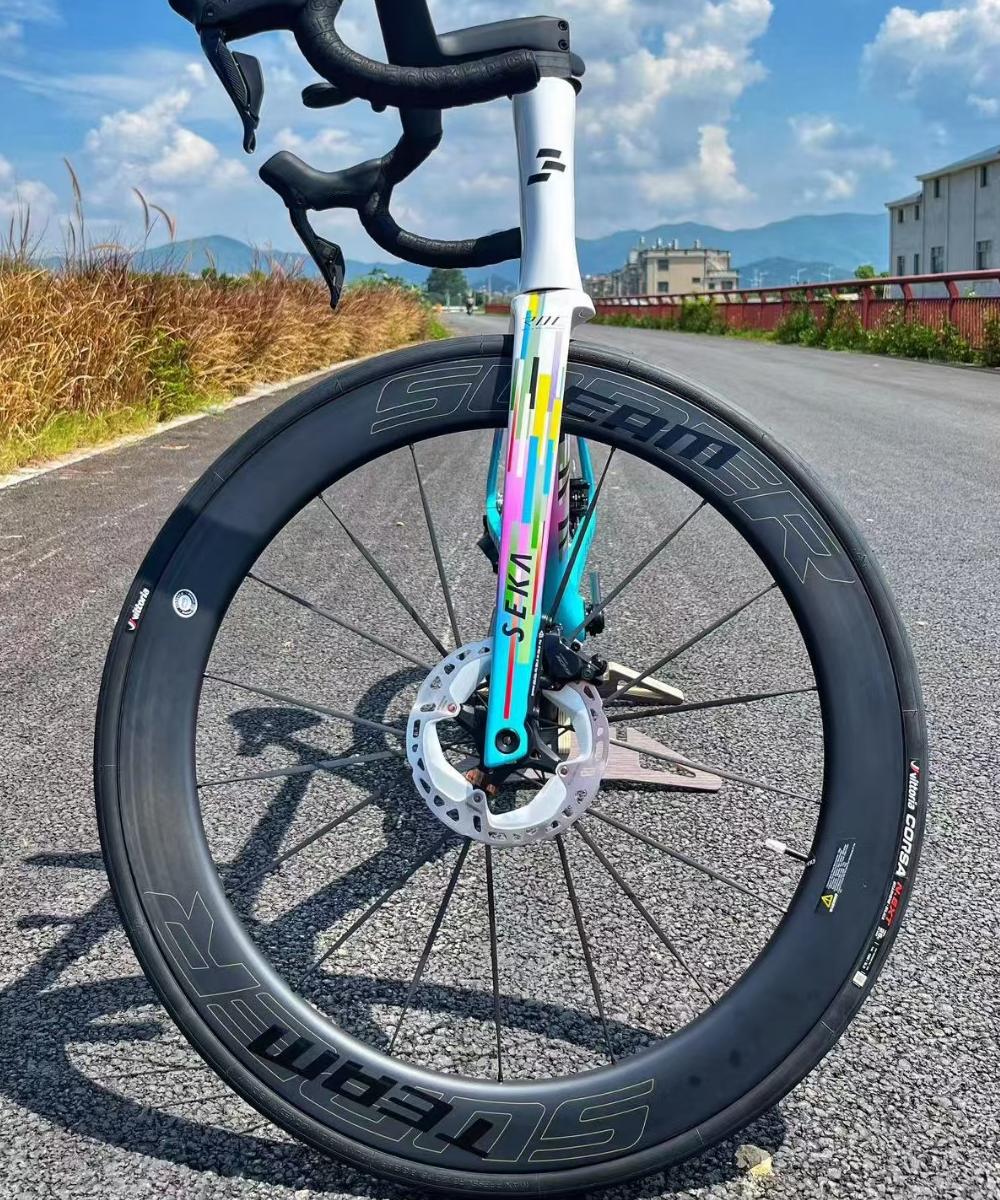
A deep-section front wheel can respond noticeably to gusts and changing wind angles.
The rider may feel the front of the bike move sideways.
That is different from a rapid steering oscillation.
The response should therefore match the problem.
If the bicycle is being pushed by a gust, maintain a stable line and avoid sudden corrections.
If the handlebars are rapidly oscillating from side to side, treat it as a possible shimmy event.
Knowing the difference helps prevent overcorrecting.
When Should You Stop Riding?
If the same bicycle develops repeated wobble at approximately the same speed, do not treat it as normal.
Stop and inspect it.
Look at:
Headset
Fork
Front wheel
Wheel bearings
Axle
Tire
Rim
Spokes
Brake installation
Cockpit and stem
Cycling UK's routine safety guidance recommends checking headset free play, wheel condition and bearing play.
If you cannot identify the cause, have the bicycle inspected by a qualified mechanic.
This is especially important if the wobble began after:
A crash
Wheel replacement
Tire replacement
Fork replacement
Headset service
Stem or handlebar changes
Prevention Is Mostly About Reducing Unknowns
A fast descent has enough variables already.
You do not want unknown tire pressure.
You do not want questionable wheel installation.
You do not want a headset with play.
And you do not want to test a new wheelset for the first time on a 60 mph mountain descent.
Test changes gradually.
Ride a familiar road.
Increase speed only when the bicycle behaves predictably.
That is a much better way to build confidence.
Final Thoughts
Preventing a bike speed wobble on descents is not about memorizing one emergency trick.
It starts with a sound bicycle.
Then comes correct tire pressure, a stable riding position, and controlled braking.
If a wobble does appear, avoid panic and reduce speed in a controlled way. Afterward, inspect the bicycle rather than assuming the event was simply “normal at high speed.”
A good descent is not the one where you reach the highest speed.
It is the one where the bike remains predictable from the top of the hill to the bottom.
FAQ
Q1: How can I prevent a bike speed wobble on descents?
Check the headset, wheels, axles, tires,s and tire pressure before fast descents. Use a relaxed upper body, smooth steering, ng and controlled braking.
Q2: Should I grip the handlebars harder during a speed wobble?
A very tight grip can transmit unwanted movement. Maintain a secure but controlled grip and keep the upper body relaxed.
Q3: Should I brake during a bicycle speed wobble?
If you need to reduce speed, do so smoothly and progressively. Avoid abrupt steering or braking inputs, especially while cornering.
Q4: Does tire pressure affect downhill bicycle stability?
It can. Tire pressure influences handling and tire deformation, so incorrect or inconsistent pressure can change how the bicycle behaves.
Q5: What should I check after a bike develops a speed wobble?
Inspect the headset, fork, wheel installation, bearings, wheel trueness, tires, tire pressure, and other front-end components before another high-speed descent.